

Creatine 101
Creatine 101.
What it is, how it works, and why it belongs in your daily routine.
Backed by decades of independent research. None of it ours.
What is creatine?
A naturally occurring compound. One of the most studied in sport.
Creatine is found naturally in muscle cells and synthesized by your body from amino acids. It plays a central role in producing ATP, the energy currency your muscles and brain rely on during high-intensity effort. Creatine supplementation is studied for its role in the phosphocreatine stores muscle draws on during short, hard efforts.
How it works
Four reasons it belongs in your routine.
Studied for high-intensity performance
Creatine helps replenish ATP, your muscles' primary energy currency, during short bursts of high-intensity effort.
Studied for strength, power and recovery
Research looks at phosphocreatine resynthesis between sets and what that means for output across a session.
Studied for cognitive function and brain energy
Creatine is present in brain tissue as well as muscle. Research into memory and processing speed is active and the results so far are mixed.
Works through consistent daily use, no loading required
Creatine saturates muscle tissue over time. 5g daily for 3–4 weeks achieves the same saturation as a loading phase. Consistency is the only variable that matters.
Frequently asked questions
Everything you want to know. Answered.
What is creatine and how does it work?
Creatine is a naturally occurring compound your body makes from amino acids. In your muscles, it combines with phosphate to form phosphocreatine, your muscles' fastest energy source for high-intensity bursts. Supplementation is studied for its effect on those phosphocreatine stores between efforts.
Why 5g? Do I need to do a loading phase?
5g a day is the amount most studies use. Treat it as a studied starting point rather than a personal prescription: how much any one person needs varies with body size, muscle mass, diet and training load. A loading phase (taking 20g/day for a week) gets you there faster but isn't necessary. Daily consistency at 5g gets you to the same place within 3–4 weeks. One Merivo stick is exactly 5g. No measuring, no math.
When should I take it?
Whenever fits your routine. Creatine works through accumulation, not acute timing, consistency beats precision here. Most people take it with their morning coffee, during training, or right after. Pick a time you'll actually remember and stick with it.
Is creatine safe?
Creatine monohydrate is among the most studied supplements there is. The International Society of Sports Nutrition has reviewed the evidence and concluded it is generally safe and well-tolerated in healthy adults. Over 30 years of research and more than 1,000 peer-reviewed studies support that conclusion. As with any supplement, consult your doctor if you have a pre-existing medical condition.
Are alternative forms, Kre-Alkalyn, creatine HCl, buffered creatine, actually better?
No. A 2022 review in Nutrients (Kreider, Jäger & Purpura) compared creatine monohydrate head-to-head against every major alternative form on the market. Conclusion: creatine monohydrate remains the most bioavailable, best-evidenced, and most cost-effective form available.
What does 'third-party certified' actually mean?
Most supplement brands self-certify. They test their own products, or don't test at all, and put a seal on the label. Third-party certified means an independent organization with no financial relationship to the brand tests the actual finished product and verifies what's in it. The lab has no stake in the outcome. If the product fails, it fails.
How does NSF Certified for Sport® compare to other certifications?
NSF Certified for Sport® is the certification the major leagues require. Three things set it apart. First, banned substance scope: NSF screens against WADA, NCAA, NFL, MLB, NBA, NHL, and PGA Tour lists. Second, batch-by-batch testing: every production batch is tested before it ships, not just a one-time product approval. Third, independent facilities: NSF operates its own labs rather than outsourcing to contract labs that also work for the brands they test.
What is Creavitalis® and why does it matter?
Creavitalis® is ultra-micronized creatine monohydrate produced by AlzChem Trostberg GmbH. The same German facility that makes Creapure®, the benchmark in ultra-pure creatine. Ultra-micronized means the particles are ground to a significantly finer size than standard creatine, so Creavitalis® mixes smoothly in any liquid, hot or cold, with no grit and no chalky film. GRAS status. FSSC 22000 certified. Over 30 years of certified manufacturing at the same facility.
By the numbers
Backed by science. Built for daily use.
01.
30+
Years of research
Creatine monohydrate has been studied longer and more extensively than almost any other sports supplement.
02.
5g
Most studied daily amount
5g daily is the amount most often used in the research. Individual needs vary with body size, muscle mass and diet.
03.
NSF®
Certified for Sport
Every batch independently tested against banned substance lists. Cleared for NCAA, Olympic, and professional competition.
04.
99.9%
Verified purity
Creavitalis® is made to a spec of 99.9% creatine monohydrate or higher, verified at the raw material stage.

The evidence base
The researchers whose work we cite.
We do not fund creatine research and we do not run studies. What we do is use a creatine whose maker, AlzChem, sponsors Creatine for Health, an open scientific initiative convened with the Exercise & Sport Nutrition Laboratory at Texas A&M. Several of the researchers on its advisory board have published the papers in our research library below.
None of these researchers endorse Merivo. We cite their published work, and we link to the initiative so you can read it yourself.
Creatine for Health is sponsored by AlzChem Group AG, the maker of Creavitalis®
- Prof. Richard B. Kreider, PhD
- Exercise & Sport Nutrition Lab, Texas A&M University. Lead author of the International Society of Sports Nutrition position stand on creatine, cited in our library below.
- Prof. Darren Candow, PhD
- University of Regina. Published on creatine for older adults, sarcopenia and bone health. Two of his papers are cited below.
- Prof. Abbie Smith-Ryan, PhD
- University of North Carolina at Chapel Hill. Published on creatine across the female lifespan, cited below.
- Prof. Jeffrey R. Stout, PhD
- University of Central Florida. Long-standing researcher in creatine and exercise performance.
- Prof. Lili Yang, PhD
- University of California, Los Angeles. Researches creatine's role in immune and cellular metabolism.
Primary sources
The evidence, unfiltered.
Creatine is unusual among supplements: the evidence is public, large, and old enough to argue with. This is a working list of the primary sources, from peer-reviewed trials and meta-analyses to regulatory reviews, published between 1992 and 2025 and grouped by what each one set out to measure.
Merivo did not run any of it and does not fund it. Every entry links straight to the journal, so you can read the study rather than our summary of it.
Show the primary sources
Candow DG
Nutrition and Allergies
Soderlund K
Kerksick CM
Pereira B
Cabre HE
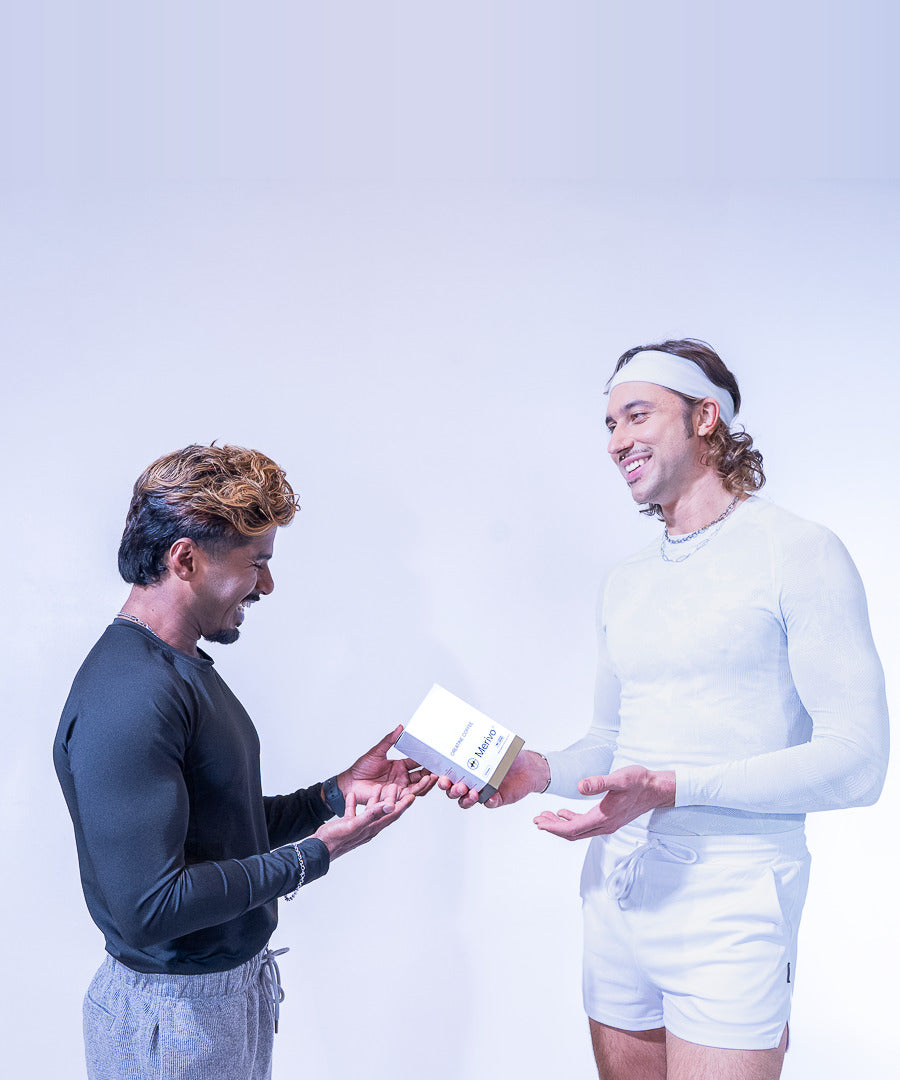
Built for daily use
A studied amount. Easy to use. Built for every day.
Two clean formulas. One daily system. Just tear, pour, and move.
- 5g, the most studied amountThe most researched daily amount, pre-measured in every stick so you never have to think about it.
- Mixes instantly. No grit.Ultra-micronized Creavitalis® mixes smoothly in hot or cold liquid. None of the chalk standard creatine leaves.
- NSF Certified for Sport®Every batch independently tested and cleared against 290+ banned substances.